
India’s clinical research landscape continues to evolve, driven by changing therapeutic priorities, broader geographic participation, and sustained investment from both domestic and global sponsors.
The January to June 2026 edition of IndiaTrialPulse by StriderDCT brings together six months of clinical trial data from the Clinical Trials Registry of India (CTRI) to identify the broader trends shaping India’s multi-site clinical research ecosystem.
Rather than looking at individual monthly movements, this half-year analysis provides a wider perspective on where India’s clinical research ecosystem is heading.
The First Half of 2026 at a Glance
During the first six months of 2026:
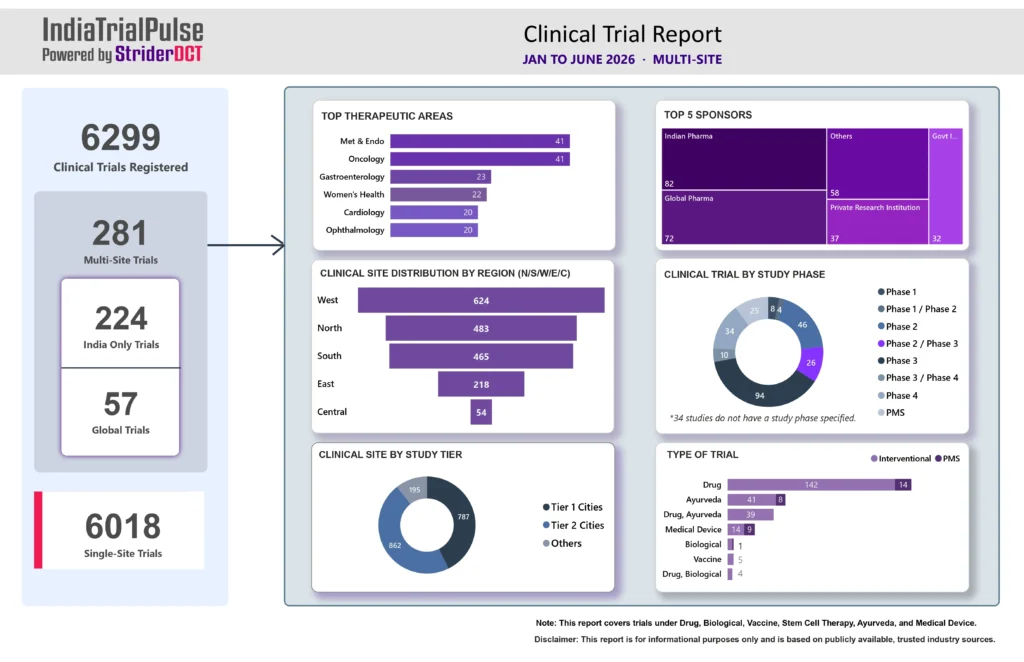
- 6,299 clinical trials were registered in India.
- 281 multi-site clinical trials were conducted across the country.
- 224 India-only studies significantly outnumbered 57 global studies, highlighting the continued strength of domestic clinical research activity.
While single-site studies continue to account for the majority of registrations, the growth in multi-site trials reflects increasing confidence in conducting larger, geographically distributed studies. The therapeutic, sponsor, and geographic patterns below are drawn specifically from this multi-site cohort of 281 trials.
Therapeutic Priorities Continue to Evolve
Metabolic & Endocrinology and Oncology emerged as the joint leading therapeutic areas among multi-site trials, followed by Gastroenterology, Women’s Health, Cardiology, and Ophthalmology.
While oncology has consistently remained one of India’s most active research segments, the rise of metabolic disorders reflects the growing burden of chronic diseases. The presence of multiple therapeutic areas among the top contributors also suggests a more balanced and diversified clinical development pipeline.
Sponsor Participation Remains Strong
Indian Pharma led overall sponsor activity among multi-site trials, closely followed by Global Pharma, while private research institutions and government organizations continued to contribute significantly. This balanced participation shows India’s research environment continues to attract both local and international investment while supporting collaborative research initiatives.
A Shift Beyond Traditional Research Hubs
Perhaps the most interesting insight from this report comes from the geographic distribution of clinical trial sites within India’s multi-site studies.
For the first time in the IndiaTrialPulse series, among the country’s 281 multi-site trials, Tier 2 cities recorded more participating clinical sites than Tier 1 cities:
- Tier 2 cities: 862 sites
- Tier 1 cities: 787 sites
This is more than a statistical milestone. It reflects the gradual expansion of India’s multi-site clinical research networks beyond established metropolitan centers and points toward increasing operational maturity across emerging research locations.
For organizations exploring decentralized or hybrid clinical trial models, this trend reinforces the importance of building capabilities beyond traditional urban hubs, particularly when planning multi-city and multi-region study designs.
Looking Ahead
The first six months of 2026 present a clear picture of a multi-site research ecosystem that is becoming more mature, more geographically distributed, and increasingly diverse in its research priorities. The continued growth of India-only studies, sustained sponsor participation, and the expanding role of Tier 2 cities in multi-site networks all point toward an ecosystem steadily strengthening its operational foundation.
Through IndiaTrialPulse, StriderDCT will continue to monitor and decode these developments, providing data-driven insights into India’s evolving clinical trial landscape.